
Canon EOS 5D Mark IV Review (2026): Is This DSLR Still Worth It?
This website contains affiliate links from trusted partners. If you purchase through a link on this site, I may earn a commission at no extra cost to you. As an Amazon Associate, I earn from qualifying purchases. See my Privacy Policy and Disclosure for more information.
If there’s one camera that’s earned absolute legend status among photographers, it’s the Canon EOS 5D Mark IV. And I’m not exaggerating.
This camera has been dragged through deserts, tossed in backpacks, hauled across airports, and perched on more cliff edges than I can count.
It’s the kind of gear you bring when the conditions get unpredictable, but the shot still matters.
But here’s the big question.
Is the Canon EOS 5D Mark IV still worth buying today?
With mirrorless cameras taking over the photography world, a lot of people wonder if this DSLR icon is still relevant, or if it’s officially been replaced by newer tech.
So I’m breaking it all down for you.
In this review, we’ll cover:
• Image quality and real-world performance
• Video capabilities
• Autofocus and low-light shooting
• Travel and adventure usability
• Who this camera is actually best for
And of course… whether it’s still worth the investment in 2026.
If you’re considering the Canon EOS 5D Mark IV for travel photography, landscape photography, or professional work, this guide will help you decide if it’s the right camera for you.
Canon EOS 5D Mark IV Quick Specs
Before we dive deep into performance, here’s a quick look at the Canon EOS 5D Mark IV’s core specs, and more importantly, what they mean if you’re a travel or adventure photographer.
Also, if you want more information on adventure photography itself, here is the full guide!
Sensor: 30.4 MP Full-Frame CMOS
Right out of the gate, this is one of the biggest reasons photographers love the 5D Mark IV.
A full-frame sensor means better low-light performance, stronger dynamic range, and that dreamy background blur everyone wants in their photos.
The 30.4 megapixels also give you plenty of resolution to crop images without sacrificing quality.
As a travel photographer, this is huge.
Sometimes you can’t physically get closer to your subject. Having extra megapixels means you can crop in later and still end up with a sharp, professional-looking image.
And if you sell prints? Even better.
The files coming out of the 5D Mark IV are more than detailed enough for large wall prints.
ISO Range: 100–32,000 (Expandable to 102,400)
Translation: this camera handles low light like a champ. This is one of the first things I noticed when I started shooting with the 5D Mark IV.
If you’re shooting sunrise hikes, blue hour cityscapes, or astrophotography in remote places, this is where a full-frame sensor really shines.
You can comfortably push the ISO much higher than you could on a crop sensor camera without completely destroying your image with noise.
For travel photography, this matters more than people realize.
You don’t always have a tripod. You don’t always have perfect lighting. Sometimes you’re shooting handheld in dim alleyways, inside old churches, or under a sky full of stars.
The 5D Mark IV gives you the flexibility to still get the shot.
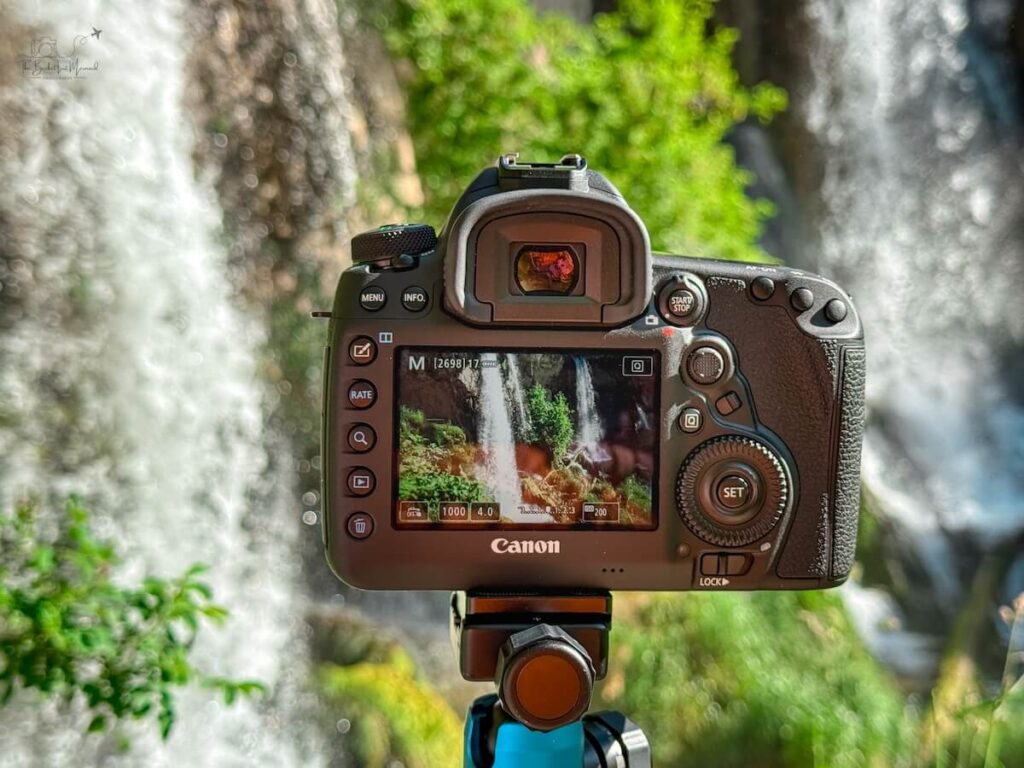
Autofocus System: 61 AF Points
The autofocus on this camera is fast, reliable, and incredibly accurate.
This becomes especially useful when you’re shooting moving subjects like wildlife, street photography, or even travel companions running across a scenic viewpoint.
Canon’s autofocus system on the 5D series has always been solid, and the 5D Mark IV continues that reputation.
It locks onto subjects quickly and rarely hunts for focus, even in lower light situations.
Continuous Shooting: 7 Frames Per Second
Seven frames per second isn’t the fastest burst speed on the market, but for most travel photography situations, it’s more than enough.
This is great for capturing action moments like:
- Waves crashing along the coast
- Wildlife movement
- Adventure sports
- Candid moments during travel
If you’re primarily shooting landscapes or travel scenes, you likely won’t need anything faster than this.
My Go-To Travel Cameras: Canon EOS M50 mark II | Canon EOS 5D mark IV | What’s in My Camera Bag?
Video: 4K at 30fps
The 5D Mark IV does offer 4K video, which was a big deal when the camera first launched.
However, there are a couple of trade-offs here.
The camera uses a pretty heavy crop when shooting 4K, which means your lenses appear more zoomed in than normal. The files are also quite large since Canon uses Motion JPEG.
For photographers who occasionally shoot video while traveling, it works well. But if video is your primary focus, there are definitely newer cameras that handle it better.
Weight: 890 g (1.96 lbs)
Let’s be honest about something. This camera is not lightweight.
When you add a professional lens to the setup, your travel camera kit can start to feel pretty hefty after a full day of exploring.
But here’s the upside. That weight comes with durability.
The 5D Mark IV feels incredibly solid in your hands, and the weather-sealed body means it can handle dust, light rain, and rugged travel environments much better than many smaller cameras.
For adventure photographers shooting in unpredictable conditions, that durability is a big advantage.
Battery Life: Up to 900 Shots
One of the biggest perks of DSLR cameras like the 5D Mark IV is battery life.
Mirrorless cameras tend to burn through batteries quickly, especially when you’re using electronic viewfinders or recording video.
The 5D Mark IV easily lasts an entire day of shooting for most photographers.
I even use knock off batteries and it still last longer than other cameras I’ve used.
For travel days, long hikes, or remote locations where charging isn’t always possible, that’s a massive benefit.
Pros of the Canon 5D Mark IV
Even though the Canon EOS 5D Mark IV has been around for a while, there’s a reason it’s still such a respected camera among photographers.
This camera delivers incredible image quality, reliable performance, and the kind of durability that travel photographers really appreciate when shooting in unpredictable environments.
Here are some of the biggest advantages of the 5D Mark IV.
1. Incredible Image Quality
The image quality from the Canon EOS 5D Mark IV is still outstanding. Seriously, I constantly gawk at the images I’m able to get.
The 30.4 megapixel full-frame sensor captures an impressive amount of detail, making it perfect for landscape photography, travel photography, and large prints.
Colors come out rich and natural straight out of the camera, and the files give you a lot of flexibility when editing.
You can recover shadows, adjust highlights, and still maintain a clean, professional-looking image.
For photographers who love editing their travel photos in Lightroom, the dynamic range on this camera makes a big difference.
2. Excellent Low Light Performance
Low-light performance is one of the biggest strengths of the 5D Mark IV.
Because it uses a full-frame sensor, it handles higher ISO settings much better than most crop sensor cameras.
This is especially helpful for travel photographers who frequently shoot in:
- sunrise or sunset lighting
- dim city streets
- indoor architecture
- nighttime landscapes
I lowkey hate shooting with a tripod while adventuring, so this is a big plus for me. You can push the ISO quite high while still maintaining usable image quality.
For anyone interested in astrophotography or night photography while traveling, this camera performs really well.
3. Extremely Durable Build
The Canon EOS 5D Mark IV is built like a tank.
The magnesium alloy body and weather sealing help protect the camera from dust, light rain, and harsh outdoor environments.
If you’re the type of photographer who shoots in national parks, on hiking trails, or in changing weather conditions, that durability becomes a huge advantage.
It’s a camera designed for professionals who need gear they can rely on.
Read More – Best Backpacks for Travel Photography
4. Reliable and Accurate Autofocus
The autofocus system on the 5D Mark IV is fast, accurate, and very dependable.
It uses a 61-point autofocus system that locks onto subjects quickly and performs well even in lower light conditions.
For travel photography, this is especially useful when you’re capturing moments quickly.
I prefer to shoot with back button focusing and this gives me even more control with this camera.
5. Long Battery Life
One of the biggest advantages of DSLR cameras is battery life, and the 5D Mark IV delivers here.
You can often get close to 900 shots on a single battery, depending on how you’re using the camera.
For travel photographers, that’s incredibly helpful.
Long travel days, hikes, and full-day sightseeing adventures can drain smaller mirrorless cameras quickly. With the 5D Mark IV, you’re much less likely to burn through multiple batteries in a single day.
6. Dual Memory Card Slots
The 5D Mark IV includes two memory card slots: one CompactFlash slot and one SD card slot.
This allows you to back up your photos automatically while shooting.
For professional photographers or anyone capturing once-in-a-lifetime travel moments, this adds an extra layer of security in case a memory card fails.
Cons of the Canon 5D Mark IV
While the Canon EOS 5D Mark IV is an incredibly powerful camera, it’s definitely not perfect, especially compared to some of the newer mirrorless options on the market.
Here are a few of the biggest downsides to consider before investing in this camera.
1. It’s Heavy
There’s no way around it… the 5D Mark IV is a fairly heavy camera.
The body alone weighs almost 2 pounds, and once you add a professional lens to the setup, your camera kit can start to feel pretty substantial.
You should feel my shoulders after I put my 100-400mm on it! Whew!
For travel photographers who spend long days exploring cities, hiking trails, or carrying gear through airports, that extra weight can add up quickly.
If portability is your top priority, a smaller mirrorless camera might be a more comfortable option for travel.
That said, the weight does come with a benefit: durability and a solid build quality that many photographers still prefer.
Note that I never use a neck strap with this camera. It’s so uncomfortable. Instead, I use a durable cross-body strap by Blackrapid.
2. 4K Video Has a Heavy Crop
While the Canon EOS 5D Mark IV does shoot 4K video, it comes with a significant crop.
This means that when you switch to 4K recording, your field of view becomes much tighter than expected.
For travel vloggers or creators who rely heavily on wide-angle shots, this can be a bit limiting.
With that being said, it definitely isn’t the size of a vlogging camera and I need a tripod every time I film and end up switching to my phone eventually.
3. No In-Body Image Stabilization
Unlike many modern mirrorless cameras, the 5D Mark IV does not include in-body image stabilization.
Instead, stabilization depends on the lens you’re using.
While many Canon lenses do include optical stabilization, having stabilization built directly into the camera body can make handheld shooting much easier, especially in low light conditions.
For travel photographers who shoot handheld frequently, this is something to keep in mind.
Read More – Best Lenses for Travel Photography
4. Older DSLR Technology
The 5D Mark IV was released in 2016, which means it doesn’t include some of the newer technology found in modern mirrorless cameras.
Features like:
- electronic viewfinders
- advanced subject tracking
- improved eye autofocus
- lighter camera bodies
… are now common in many newer models.
That doesn’t mean the 5D Mark IV is outdated (it’s still an incredibly capable camera) but newer systems do offer more advanced technology.
5. No Flip Screen
One feature that many modern cameras include, but the Canon EOS 5D Mark IV does not, is a flip-out screen.
The camera does have a touchscreen LCD, which is great for reviewing images and adjusting focus when shooting in live view. However, the screen does not fold or come out in any way.
A flip screen makes it much easier to frame shots when you’re in front of the camera or shooting at awkward angles.
I also have a Canon EOS M50 Mark II with this feature, and I do miss it on this camera.
6. Expensive (Especially for a DSLR)
Even though the 5D Mark IV has been on the market for several years, it’s still a relatively expensive camera.
For many photographers, that price point makes it harder to justify compared to newer mirrorless options that offer similar or even more advanced features.
However, for photographers who value reliability, durability, and exceptional image quality, the investment may still be worthwhile.
2026 Camera Alternatives
I actually did a showdown between this camera and a cheaper alternative (the M50. You can check out the results here!
In the meantime, here are all of the alternatives for the Canon 5D Mark IV.
1. Canon EOS R6 Mark II
If you want the modern mirrorless upgrade to the 5D series, the R6 Mark II is one of the best options available.
This camera keeps the professional performance photographers love but adds a ton of modern features that DSLRs just don’t have.
Why it’s a great alternative:
- Much better autofocus with eye and subject tracking
- In-body image stabilization
- Fully articulating flip screen
- Much better video capabilities
- Significantly lighter than the 5D Mark IV
For travel photographers, the autofocus and stabilization alone make a huge difference when shooting handheld.
Downside: slightly lower resolution at 24MP compared to the 5D Mark IV’s 30MP.
2. Canon EOS R5
If the 5D Mark IV had a modern mirrorless cousin with superpowers, it would be the Canon R5.
This camera is basically the next generation of Canon’s pro photography line, with serious upgrades across the board.
What makes it impressive:
- 45 megapixels (huge upgrade from the 5D Mark IV)
- Incredible autofocus tracking
- 8K video
- In-body stabilization
- Fully articulating touchscreen
For landscape photographers and travel photographers who love huge print quality, this camera is a dream.
The main drawback? It’s definitely a premium-priced camera.
3. Sony A7 IV
Even though it’s outside the Canon ecosystem, the Sony A7 IV is one of the most popular cameras among travel photographers right now.
Sony really nailed the balance between resolution, autofocus, and portability.
Highlights include:
- 33MP full-frame sensor
- Excellent autofocus with eye tracking
- Strong video performance
- Compact mirrorless design
- Huge selection of lenses
Many travel creators love Sony because the cameras are lighter and extremely reliable for hybrid photo/video work.
4. Canon EOS R8
If you love Canon but want something much lighter for travel, the R8 is a fantastic option.
This camera packs impressive performance into a much smaller body, which makes it great for travel photographers trying to keep their gear minimal.
What makes it appealing:
- Lightweight and compact
- Excellent Canon autofocus system
- Great low-light performance
- Fully articulating screen
The biggest trade-off is that it’s not quite as rugged or professional-grade as the 5D Mark IV. And it only is 25.6 MP.
But for travel photography? It’s incredibly capable.
Comparison Table of Options
| Camera | Sensor | Megapixels | Stabilization | Flip Screen | Video | Weight |
|---|
| Canon EOS 5D Mark IV | Full Frame DSLR | 30.4 MP | Lens Only | No | 4K (cropped) | 890 g |
| Canon R6 Mark II | Full Frame Mirrorless | 24.2 MP | In-Body | Yes | 4K 60p | 670 g |
| Canon R5 | Full Frame Mirrorless | 45 MP | In-Body | Yes | 8K | 738 g |
| Sony A7 IV | Full Frame Mirrorless | 33 MP | In-Body | Yes | 4K 60p | 659 g |
| Canon R8 | Full Frame Mirrorless | 24.2 MP | Digital/Lens | Yes | 4K 60p | 461 g |

Canon 5D Mark IV FAQ
All of your questions about the Canon EOS 5D Mark IV answered.
Canon EOS 5D Mark IV: Before You Buy Checklist
The Canon EOS 5D Mark IV is an incredible camera, but before you invest in one, there are a few things worth thinking about, especially if you’re planning to use it for travel and adventure photography.
Here’s a quick checklist to help you decide if it’s the right camera for you.
✔️ You Want Professional-Level Image Quality
The 30.4 MP full-frame sensor delivers beautiful detail, strong dynamic range, and excellent low-light performance.
If your goal is high-quality travel photos, landscape photography, or large prints, the 5D Mark IV absolutely delivers.
✔️ You’re Comfortable Carrying a Larger Camera
This camera is built like a tank, but that also means it’s heavier than most modern mirrorless options.
If you frequently hike, travel long distances, or prefer lightweight gear, it’s worth considering how much camera weight you’re comfortable carrying throughout the day.
✔️ You Already Own Canon EF Lenses (or Plan to Invest in Them)
One of the biggest advantages of the 5D Mark IV is access to Canon’s extensive EF lens lineup.
If you already own EF lenses, this camera fits perfectly into that system. And because EF lenses have been around for years, you can often find excellent used options at more affordable prices.
✔️ Photography Is Your Main Focus
The 5D Mark IV is a photography powerhouse.
But if your work leans heavily toward video or content creation, newer mirrorless cameras may offer better video features, flip screens, and stabilization.
✔️ You Want a Camera That’s Built to Last
The 5D Mark IV is known for its durability.
The weather-sealed magnesium alloy body is designed to handle challenging outdoor environments, making it a great choice for photographers who shoot in national parks, deserts, mountains, or unpredictable weather conditions.
For adventure photographers, that reliability can be a major advantage.
Final Thoughts on the Canon EOS 5D Mark IV
The Canon EOS 5D Mark IV has earned its reputation as one of the most respected cameras in Canon’s lineup… and honestly, it’s not hard to see why.
This camera delivers incredible image quality, excellent low-light performance, and the kind of durability that adventure photographers truly appreciate. It’s the kind of camera you can take from mountain viewpoints to city streets to desert landscapes without worrying whether it can handle the conditions.
And when it comes to photography, the results still hold up beautifully.
Even years after its release, the 30.4 MP full-frame sensor produces detailed, professional-quality images that are perfect for travel photography, landscape photography, and large prints.
That said, the camera world has evolved quite a bit since the 5D Mark IV was released.
Many newer mirrorless cameras now offer lighter bodies, in-body stabilization, advanced autofocus tracking, and better video features. For photographers who prioritize portability or hybrid photo and video work, those modern features can be a big advantage.
But if your primary focus is photography (and you want a camera that’s powerful, reliable, and built to last) the Canon EOS 5D Mark IV is still an outstanding choice.
It may not be the newest camera on the market, but it remains a professional-level workhorse that continues to produce beautiful images around the world.
More Photography Inspiration for Your Adventures
More Adventure Travel Resources
Adventure Bucket List Resources
I am here to help your travel adventures go as smoothly as possible! That way you can check off that bucket list with minimal complications and spending!
SHOP – Shop the best adventure gear and essentials on my Amazon Storefront – handpicked by a full-time adventuring mermaid!
AIRFARE – There are a few I use, but Aviasales is normally my go-to for flights without any extra fees or markups.
ACCOMMODATION – My two favorites are Booking.Com for hotels and VRBO for rentals.
GUIDED TOURS – If you are looking for quick and easy tours, check out GetYourGuide and Viator.
MULTI-DAY TOURS – For more in-depth tours that span several days, TourHub has many great options with reputable travel companies. Use my code (ALEXANDRA1GURU) for up to 5% off your next bucket list adventure.
TRANSPORTATION – You can either rent a car yourself with Discover Cars or do a guided bus tours like Big Bus Tours.
SIM CARDS – Avoid expensive roaming charges with an eSim card with Airalo. Personally, I prefer wifi boxes, and recommend WiFi Candy (get 10% of with the code THEBUCKETLISTMERMAID).
TRAVELER’S INSURANCE – Check out VisitorsCoverage for affordable insurance plans. If you are a nomad or remote worker, I would check out SafetyWing.
SEE MORE – Adventure Resources | Photography Resources
See Some Photos You Like?
Check out my full photography page for a full gallery and prices.